




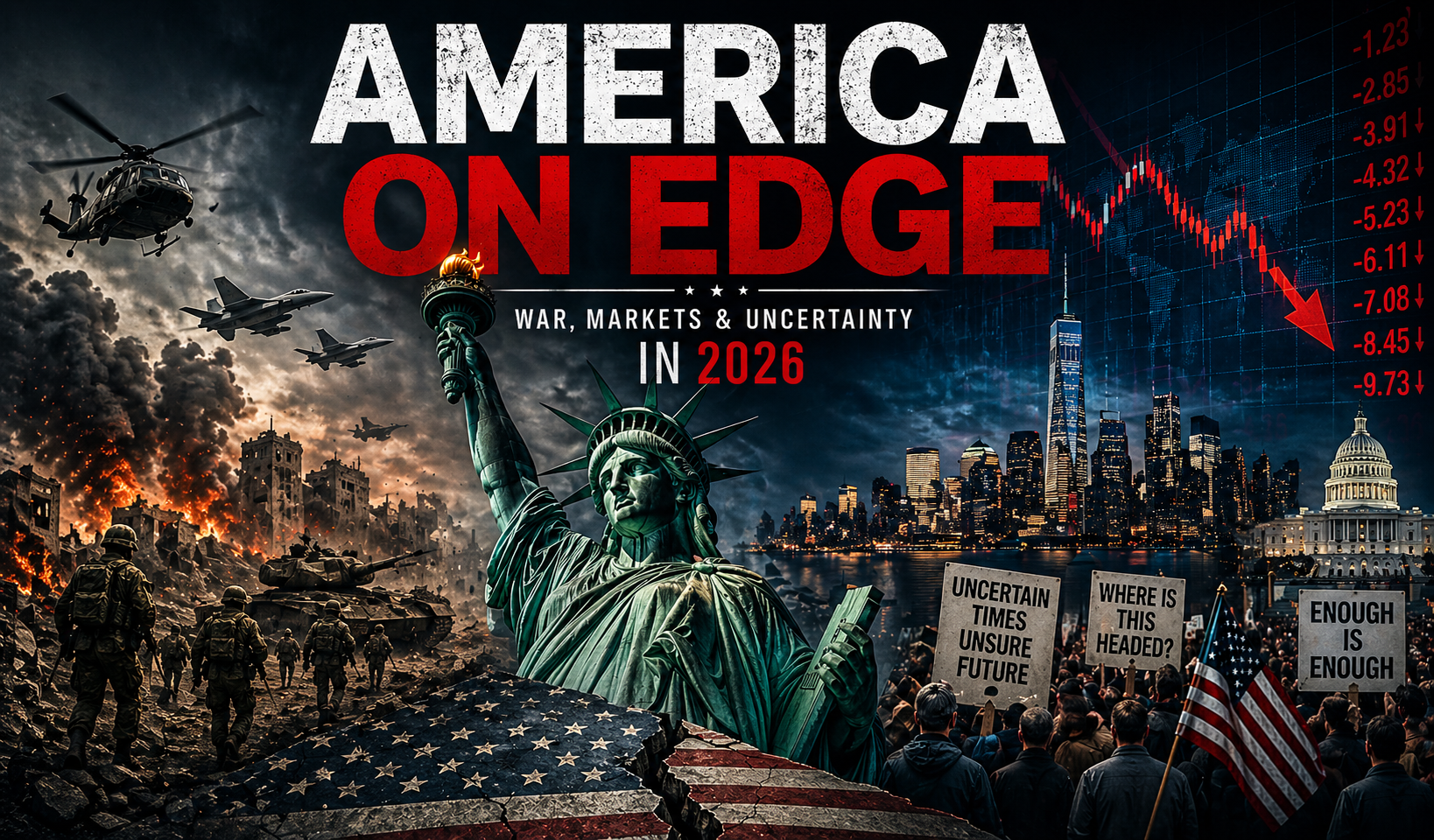
America on Edge 2026 highlights the growing tension between war, economic growth, and uncertainty shaping the United States today.
In 2026, the United States finds itself navigating a moment of unusual contradiction. On the surface, financial markets are surging, technology investment is booming, and global influence remains strong. Yet beneath that confidence lies a growing sense of unease fueled by geopolitical tensions, economic anxiety, and a shifting political landscape. For many Americans, the year feels defined not by stability, but by uncertainty.
A World on the Brink
At the center of global concern is the escalating standoff between the United States and Iran. What began as a series of diplomatic disagreements has evolved into a broader geopolitical flashpoint. The recent seizure of an Iranian-flagged vessel near the Strait of Hormuz has intensified fears of wider conflict, raising alarms across international markets and political circles alike.
The stakes are high. The Strait of Hormuz remains one of the world’s most critical oil transit routes, and any disruption threatens global energy supplies. As oil prices react to every new development, governments and businesses are bracing for ripple effects that could reach far beyond the Middle East.
Despite ongoing attempts at diplomacy, progress has been inconsistent. Talks have stalled, rhetoric has sharpened, and uncertainty continues to dominate headlines. For Americans, the question is no longer whether tensions will affect daily life but how deeply.
The Economic Paradox
At home, the economic picture is equally complex. Wall Street is thriving, with major indices reaching record highs. Investors, buoyed by strong corporate earnings and continued innovation in sectors like artificial intelligence, appear optimistic about the future.
Yet this optimism is not shared equally. Across the country, consumer confidence has dropped to one of its lowest levels in years. Rising costs, persistent inflation concerns, and fears of economic instability are weighing heavily on households.
This growing disconnect between financial markets and everyday experience has created what analysts are calling “the great economic divide.” While portfolios expand, purchasing power feels constrained. Essentials from housing to groceries remain expensive, and wage growth has struggled to keep pace.
The result is a fragile balance: a strong market coexisting with widespread financial anxiety.
Politics in a Time of Tension
Adding to the uncertainty is a rapidly evolving political environment. With midterm elections approaching, new issues are reshaping the national conversation. Among the most unexpected is the rise of opposition to large-scale data center developments projects tied to the expanding demands of artificial intelligence and cloud computing.
Communities across the country are pushing back, citing concerns over environmental impact, energy consumption, and local infrastructure strain. What was once a niche issue has quickly become a defining topic in key battleground regions.
Meanwhile, leadership under Donald Trump continues to influence both domestic and international policy. Trade decisions, tariff strategies, and foreign policy moves are all contributing to an atmosphere where economic and geopolitical risks are closely intertwined.
Public trust in institutions remains low, and political polarization shows little sign of easing. For many voters, the upcoming elections represent not just a choice of candidates, but a referendum on the country’s direction.
The Rise of the Intelligence Economy
Even as uncertainty grows, innovation continues to accelerate. One of the most notable trends of 2026 is the emergence of a new “intelligence economy,” driven by advancements in artificial intelligence and private-sector surveillance technologies.
Startups and established tech firms alike are investing heavily in tools designed to gather, analyze, and interpret vast amounts of data. From corporate security to geopolitical risk assessment, these technologies are reshaping how decisions are made at every level.
The implications are profound. On one hand, these innovations promise greater efficiency and insight. On the other, they raise critical questions about privacy, ethics, and the concentration of power in the hands of a few major players.
As the line between technology and governance continues to blur, the debate over regulation and oversight is likely to intensify.
A Nation Watching the Horizon
What defines the United States in 2026 is not a single crisis, but the convergence of many. Geopolitical tensions, economic contradictions, political shifts, and technological transformation are all unfolding at once, creating a landscape that is as dynamic as it is unpredictable.
For businesses, the challenge lies in navigating volatility while seizing new opportunities. For policymakers, it is about balancing immediate pressures with long-term strategy. And for ordinary citizens, it is about making sense of a world where confidence and concern exist side by side.
The question facing the nation is not whether change is coming it already has. The real question is how the United States will adapt to a reality where uncertainty is no longer the exception, but the norm.
Conclusion
“America on Edge” is more than a headline it is a reflection of a pivotal moment in history. As 2026 unfolds, the forces shaping the nation are testing its resilience, redefining its priorities, and challenging its sense of stability.
In times like these, clarity is hard to find. But one thing is certain: the decisions made today on the global stage, in the halls of government, and within the private sector will shape the trajectory of the United States for years to come.